Abstract
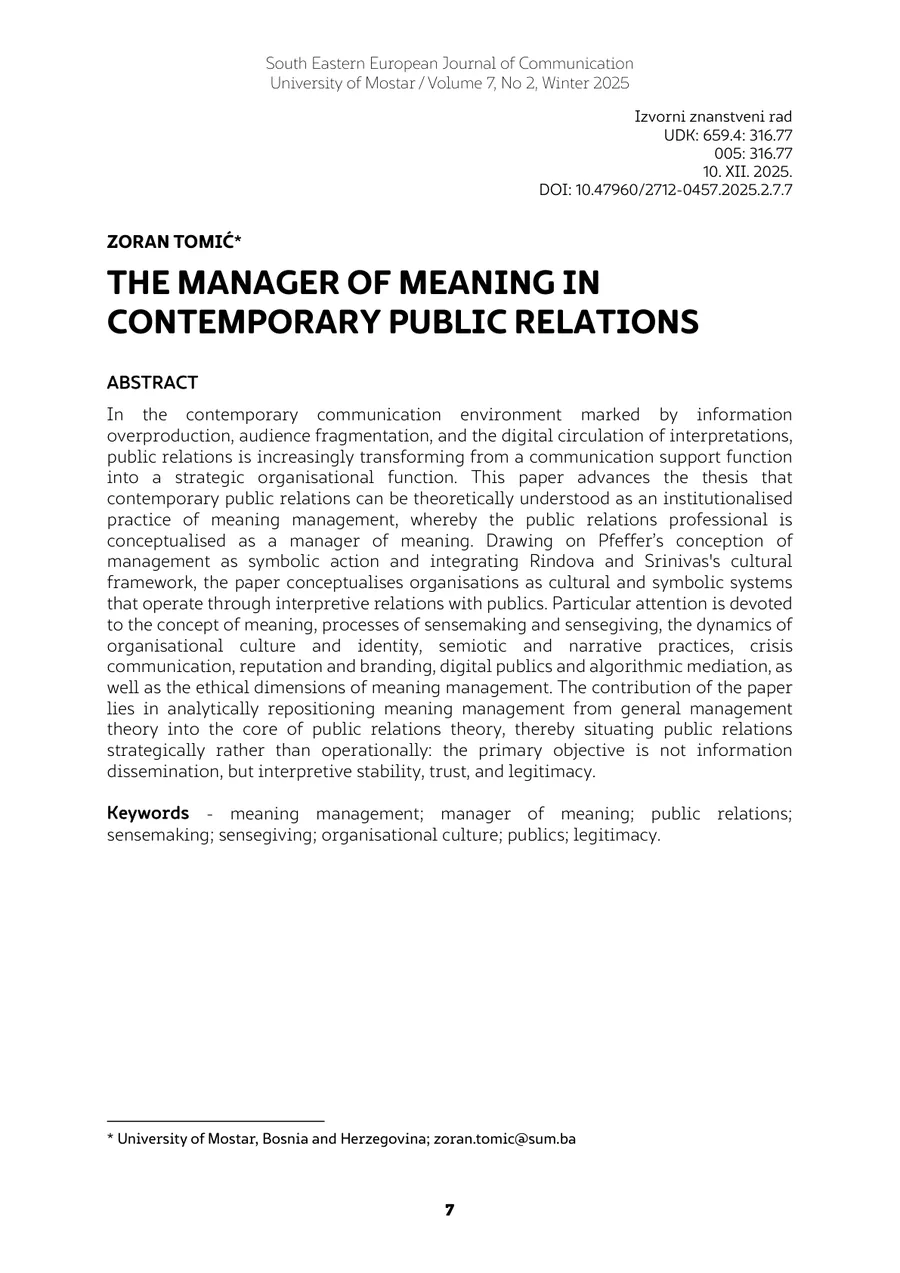
In the contemporary communication environment marked by information overproduction, audience fragmentation, and the digital circulation of interpretations, public relations is increasingly transforming from a communication support function into a strategic organisational function. This paper advances the thesis that contemporary public relations can be theoretically understood as an institutionalised practice of meaning management, whereby the public relations professional is conceptualised as a manager of meaning. The contribution of the paper lies in analytically repositioning meaning management from general management theory into the core of public relations theory: the primary objective is not information dissemination, but interpretive stability, trust, and legitimacy.
From the opening
In contemporary societies, communication functions increasingly less as the transmission of information and increasingly more as a process of producing and negotiating meaning. Information is abundant, accessible, and instantaneous; what becomes scarce is a coherent framework of meaning that enables the coordination of action and the stability of relationships. Organisations, therefore, confront not primarily the question of how to “reach” their publics, but how to ensure that their actions are intelligible and can be interpreted within acceptable and socially legitimate frameworks.
The full paper (16 pages) is available to download.
Download PDF · 0.5 MBRecommended citation
Zoran Tomić (2025). The Manager of Meaning in Contemporary Public Relations. South Eastern European Journal of Communication, Vol. 7, No. 2 (Winter 2025), University of Mostar. https://doi.org/10.47960/2712-0457.2025.2.7.7